Book Review: Cage of Stars
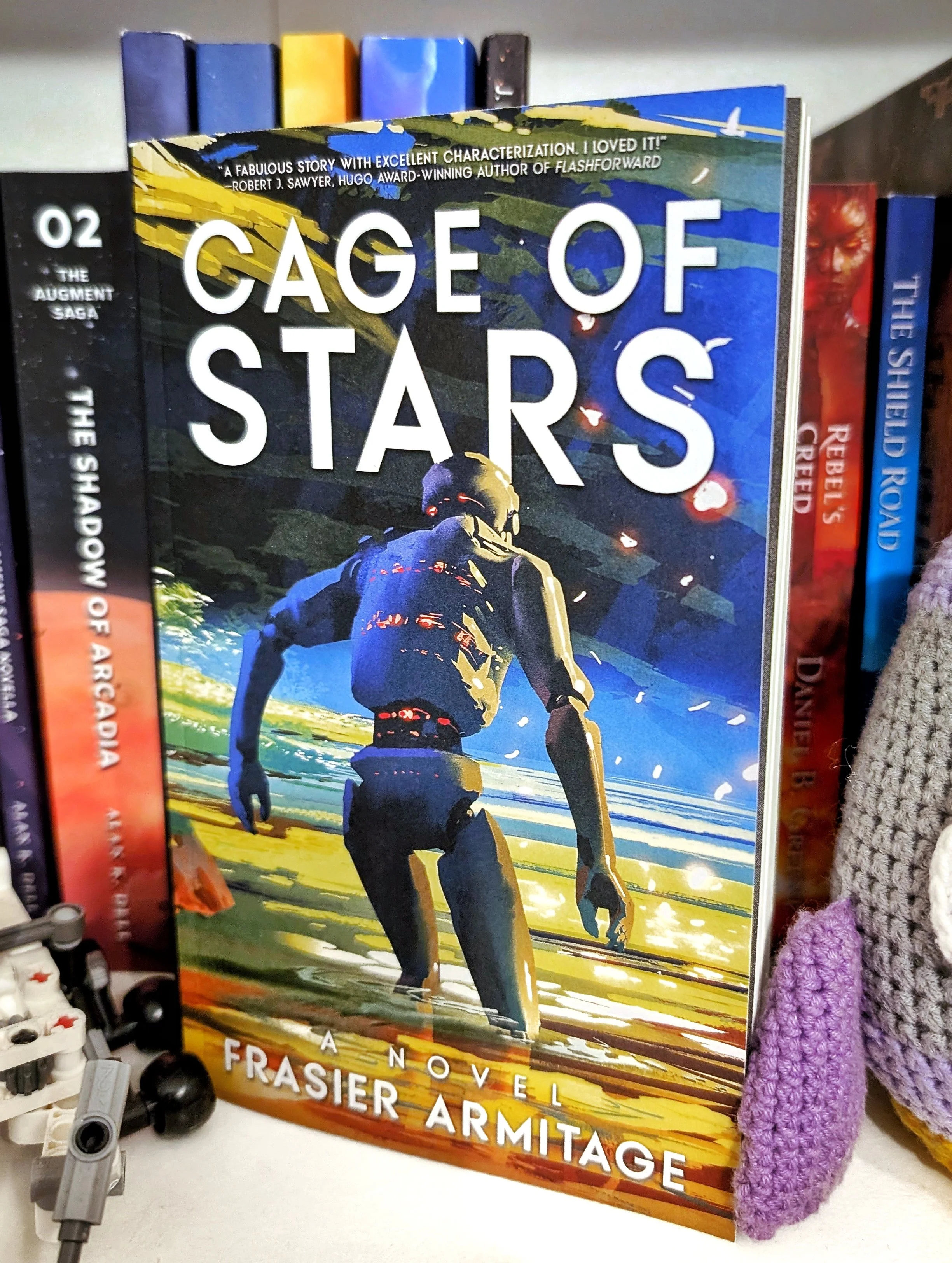
A fugitive robot running around the inside of a Dyson Sphere? Sign me the hell up! A sublime standalone sci-fi from Frasier Armitage.
If you’ve been following my blog for a while you’ll know how much I’ve enjoyed Frasier Armitage’s work in the past. You can check out my review of his novelettes Rememory and Investation here. The cover for Cage of Stars instantly popped for me. It really looks fantastic and in hindsight is perfect for the atmosphere of the story.
Blurb
HOW FAR WOULD YOU GO TO BE FREE?
Inside the paradise of a Dyson Sphere, artificial intelligence has been outlawed and hunted. When a robot is dug up at the equator, it will have to flee if it wants to survive.
Told from the different perspectives of the humans and creatures who encounter the machine as it crosses the Sphere to seek refuge at the pole, can one robot's struggle for freedom change the world?
Review
I very much enjoyed my time with Cage of Stars; it was exactly what I needed, and I ended up devouring it rather quickly. It has an unusual style that I hadn’t come across before but which is explained by Frasier in the acknowledgements. Essentially, each chapter takes the point of view of a character or object that comes into contact with the robot as he journeys across the inside of the Sphere trying to reach the pole, whether that’s a mech hunter, a futuristic chimney-sweep, various animals, or even a river. Very rarely are we actually in the point-of-view of the robot itself. It’s very well done and highlights the impact that these chance meetings have on the individuals and societies across the Sphere.
All the chapters are preceded with a little tidbit of lore from an in-universe publication that relates to the contents of the chapter and gives a broader view of the immense worldbuilding. Similar to how the Dune novels have snippets from the writings of Muad’dib, court historians, and chroniclers. It all comes together very well, especially in the paperback version which has some excellent interior design for chapter headings. The worldbuilding itself is brilliant and mysterious. We see only a fraction of the full breadth of the Sphere in this book, but we get a sense of the age of it and the influence of Scantech over its people. The morality of all of it is is somewhat grey, too. Like the Mech Hunters, are they villains or heroes? From the perspective of the robot, they are, of course, but the book immediately makes us sympathetic to their views, too.
The characters are many and varied, and though most of them only stick around for a short while, they are all very memorable and nuanced. Frasier crafts the life of the Sphere with great depth very effectively in these short passages. A lot of classic sci-fi takes this approach when distances or timespans run into the extreme and, more often than not, fails the characters by making them cardboard cut-outs in their brief presence in the story. Not so, here. Each one, from the print-girl to the rebel mechs, to honest-to-god dinosaurs, are given great care and end up really well-rounded.
The implications of the ending are left open, too. The robot truly isn’t the focus of the struggles and trials of the Sphere—his journey is his own. But his impact on the people around him works as a catalyst. What that looks like after his journey’s conclusion is beyond the scope of the book and I really like that it’s left vague in that way.
I would love to see more stories set in this world, because the physics of the inside of a Dyson Sphere is fascinating and I have no doubt that Frasier could explore it with the same depth of care and attention to detail he has shown with Cage of Stars.
I would highly, highly recommend this book to any sci-fi fans. It’s a masterpiece.