Book Review: Children of Memory
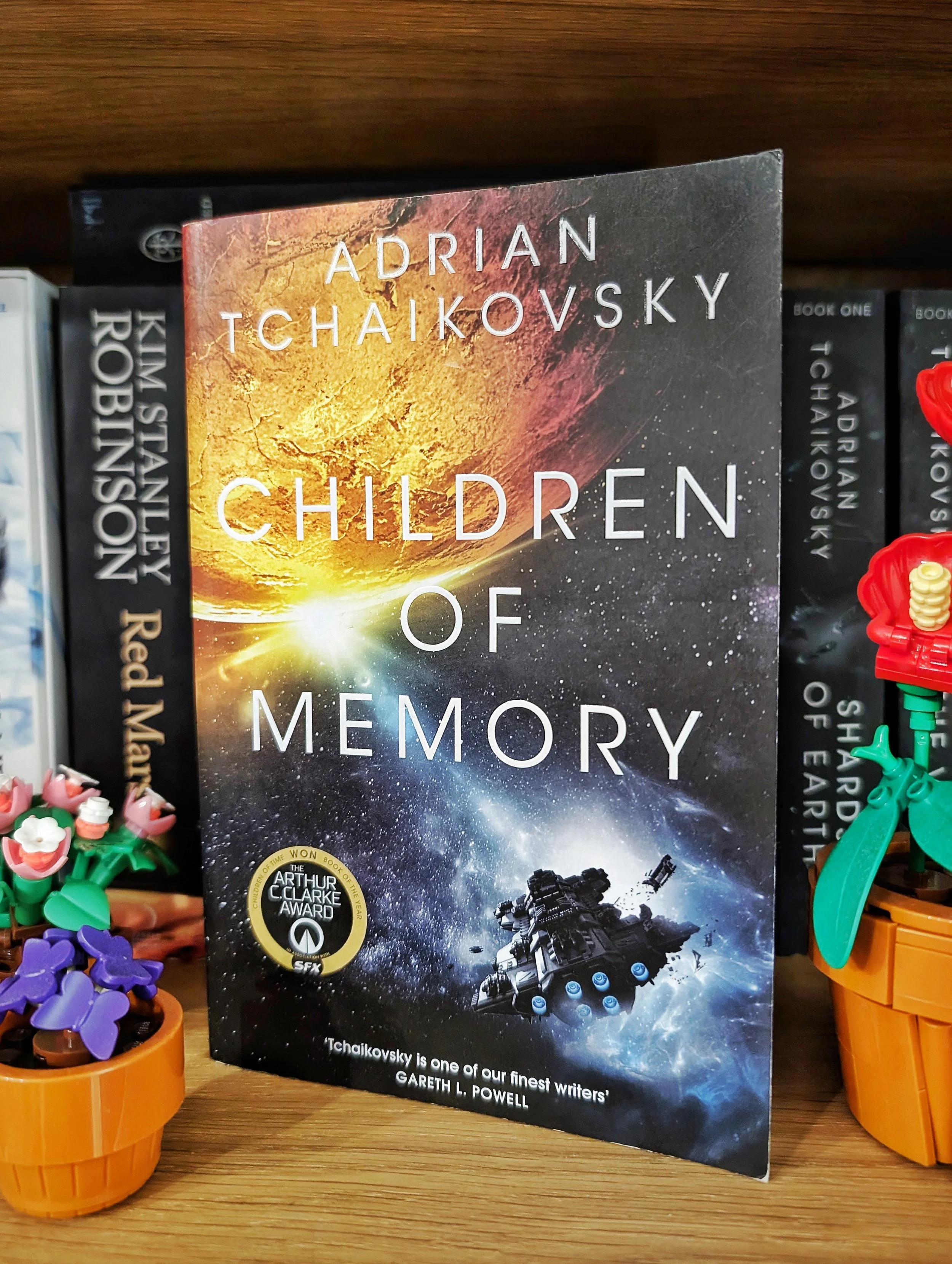
The remarkable third book in Adrian Tchaikovsky’s acclaimed Children of Time series.
It’s been a long time since I started reading this series, and it took me a lot longer to read this book than I thought it would. I started it back in October and then hit a reading slump that was in no way anything to do with the book. At one time I thought this was going to be the final book in the trilogy, but no, there’s more coming. This is some of the best modern sci-fi around, in my opinion. I’ll always recommend people to pick up Children of Time, even if that’s only as far as they read, but these sequels have been consistently great. So let’s get into the review of the third book: Children of Memory.
Blurb
On Imir, Captain Holt founded a new colony on an empty world. In the process, he created hope and a new future for humanity. But, generations later, his descendants are struggling to survive.
As harvests worsen and equipment fails, strangers appear in a town where everyone knows their neighbour. Now the inexplicable lurks in the woods and the community fears that it's being observed – that they’re not alone.
They’d be right, as explorers from the stars have arrived in secret to help this lost outpost. Confident of their superior technology, and overseen by the all-knowing construct of Doctor Avrana Kern, they begin to study their long-lost cousins from Earth.
Yet the planet hides deeper mysteries. It seems the visitors aren’t the only watchers. And when the starfarers discover the scale of their mistake, it will be far too late to escape.
Review
As always, Adrian has crafted an exquisite story with Children of Memory and I had an amazing, emotional time with it. There’s something bittersweet about the way in which the culture has formed into a full-fledged post-scarcity society—a true interspecies interstellar alliance no longer bound by the forward march of time. It’s from this mix we get the crew of the Skipper, a scout ship sent to investigate a signal around one of the old terraformers’ worlds.
We get all the usual names: The Portiid spiders Portia, Bianca, and Fabian from Kern’s World; Paul the Octopus from Damascus, and another instance of the construct of Dr Avrana Kern. There’s Jodry the Human (also of Kern’s World) as well, but our main POV character in this side of the story is Miranda, a Nodan parasite who has been given a (lab-grown) human body and who serves as Interlocutor aboard the ship. Prior to the events of the book the explorers had come across another failed terraforming world called Rourke, from which they picked up a delegation of Corvids: Gothli and Gethli, and nobody is sure whether they’re truly sentient (not even them). But Rourke is not their destination: Imir is.
The Corvids were a thoroughly fascinating addition to the series, because out of all the different Old Earth species featured, they’re the only ones who never received the Uplift Virus, so they never had any sort of accelerated evolution. As such they provide a great backdrop for the main philosophical discussion of the book: What it means to be sentient.
Miranda was a brilliant character, so full of life and energy and drive, bursting with empathy, and struggling to keep a clear grasp on herself as both a Nodan parasite housing the memories of all the people her collective has been, and a copy of the real Human Miranda who donated her memories. Her time exploring the colony on Imir was truly captivating and nail-biting.
Then there’s the flip side to the story—the people of Imir. A human colony that arrived on the sleeper ship Enkidu, cousin to the Gilgamesh from the first book. They live tough lives down on a hostile planet, dealing with failing farms, low resources, and the ever-present threat of outsiders in their minds. The main POV character here is Liff, a child of the colony, as she meets strangers and absorbs herself in stories of strange things off in the woods. The characters are given such depth that I sometimes forgot that I was reading sci-fi and not a historical fiction about frontier-town life.
I’m always astounded by Adrian’s ability to craft these nonchronological stories, preserving multiple hard-hitting twists that would never have been if they had been written in-order. And believe me, this book has a whole litany of big reveals to smack you about with and red herrings to throw you off the scent. It kept me guessing what was going on, and just when I thought I knew what was really happening, bam! Wrong.
I definitely think I enjoyed this one more than Children of Ruin. I think it was more to do with the frustrations of communication in that one. There’s almost none of that here. And it widens the scope of the series significantly by the end. Simply fantastic. I can’t wait for Children of Strife.