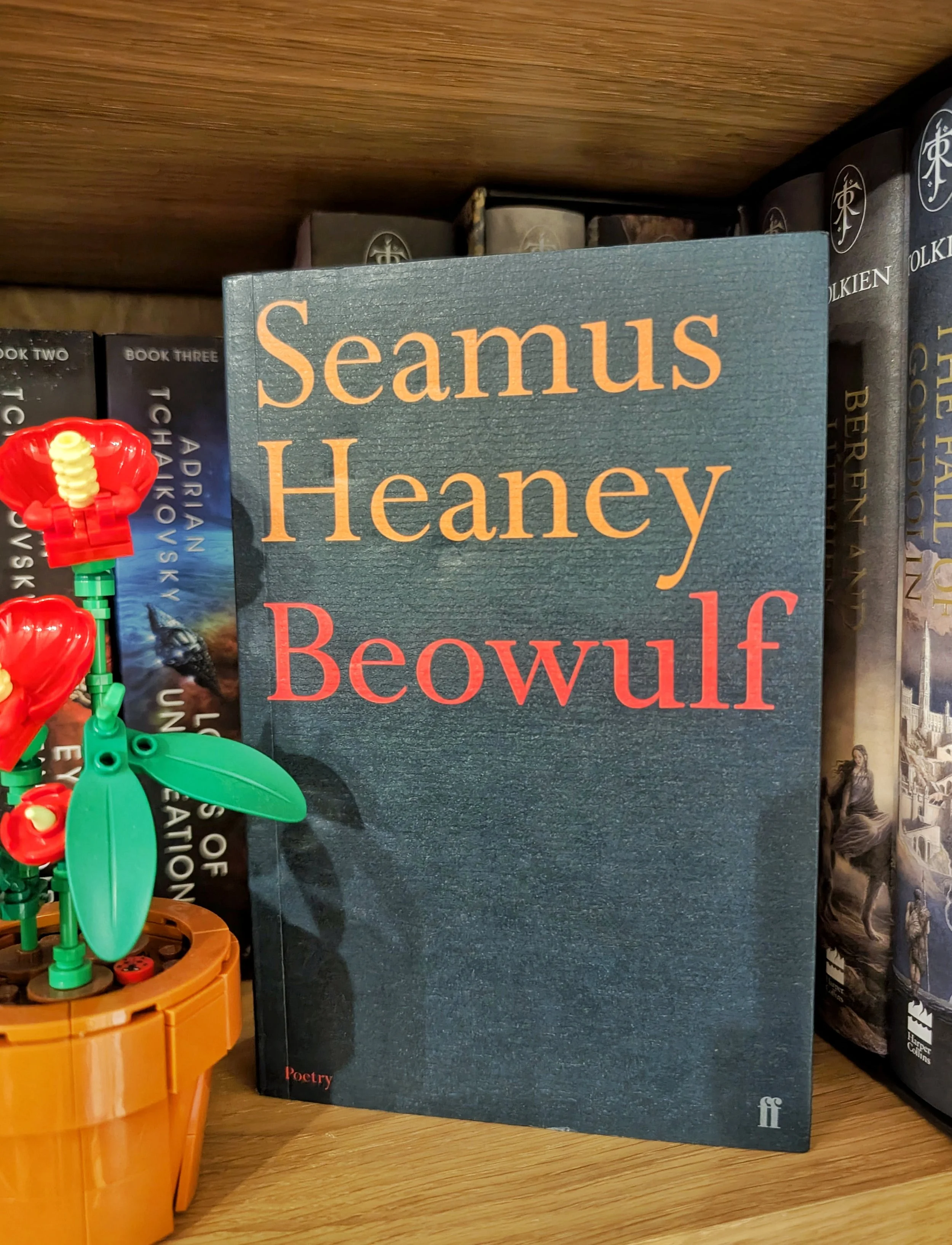
Seamus Heaney’s marvellous English translation of the classic Anglo-Saxon epic poem.
Ever since I read The Epic of Gilgamesh, I’ve had a hankering for diving into other ancient works that I have missed out on. Beowulf was the first such tale that came to mind. Not ancient in the anthropological sense, having been written somewhere between the seventh and tenth centuries CE, it’s nonetheless a work of seminal importance in western culture. I have known the broad strokes of the tale through cultural osmosis for much of my life but I had never read it for myself. So I decided it was time to change that. I had no idea which of the many translations I should go for, but fate took that decision out of my hands when I happened upon this wonderful copy of Seamus Heaney’s version in a National Trust used bookshop (naturally). The experience has been enlightening.
Blurb
Composed towards the end of the first millennium, the Anglo-Saxon poem Beowulf is one of the great Northern epics and a classic of European literature. In his new translation, Seamus Heaney has produced a work which is both true, line by line, to the original poem, and an expression, in its language and music, of something fundamental to his own creative gift.
The poem is about encountering the monstrous, defeating it, and then having to live on, physically and psychically exposed, in that exhausted aftermath. It is not hard to draw parallels between this story and the history of the twentieth century, nor can Heaney's Beowulf fail to be read partly in the light of his Northern Irish upbringing. But it also transcends such considerations, telling us psychological and spiritual truths that are permanent and liberating.
Review
I very much enjoyed my first read of Beowulf. It was just as fascinating as I was hoping it would be. Heaney’s prose is excellent and I thought it was pretty accessible. I was surprised to find that the portion of the story I knew from cultural osmosis was pretty much the first half. The second half, while I didn’t know it as part of this particular tale, was even more surprising for its striking similarity to The Hobbit. And this makes so much sense considering that J.R.R. Tolkien was (and still is) an authoritative voice in Beowulf scholarship, having made his own influential translation of the epic. So it was both a pleasant surprise and perfectly apt to see how this piece of Anglo Saxon poetry may have influenced his writing of Bilbo’s journey. I could see so much of Thorin in Beowulf, and the unnamed thief in the epic who stoked the anger of the dragon could be a template for Bilbo. Obviously it’s not a 1:1 comparison, but the influence is plain to see. I might be very late to the party on this, but give me a break here.
Seamus Heaney’s introduction to Beowulf was interesting but rather more academic than, say, Stephen Mitchell’s introduction to Gilgamesh was. As such it didn’t stick with me quite so much, and I could happily have gone without it. I have also seen some consternation online levied at his translation of the enigmatic first word of the poem, ”Hwaet” as “So”, rather than something like “Hark”, “Listen” or “Lo” as in Tolkien’s translation. But I don’t really have a dog in that race and it seemed to work fine to me. He did explain why he did that, and explained other word choices, all of which made sense.
Overall, though, I think I enjoyed Gilgamesh a little more. Beowulf has multiple lengthy meandering asides talking about past kings and their exploits, whereas the older Mesopotamian tale was a much more straightforward narrative. But if, like me, you have never read Beowulf, then I can say it’s absolutely worthwhile to read it for yourself and I would heartily recommend this version.