Book Review: Unfinished Tales of Númenor and Middle Earth
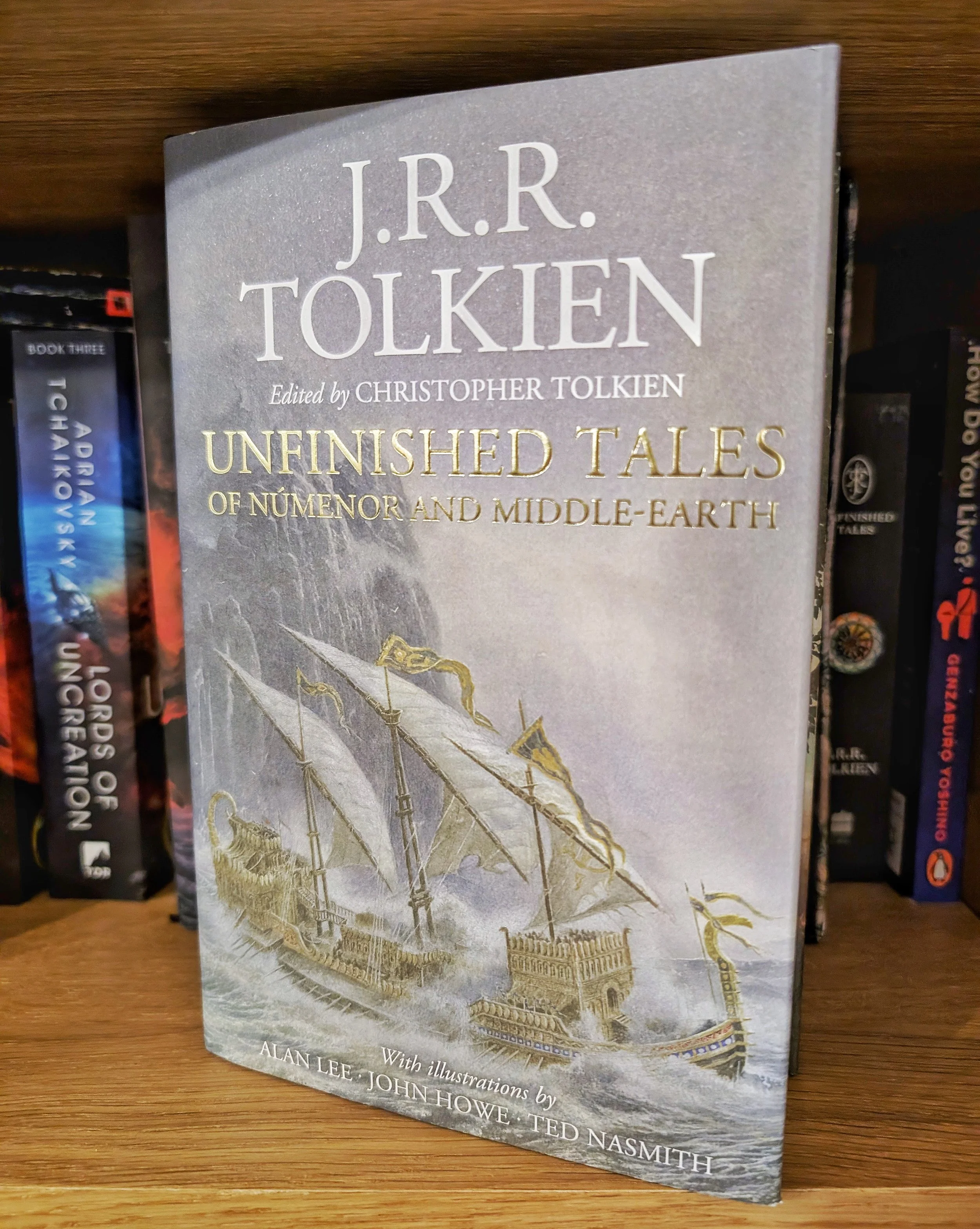
A fascinating deep look into the variants and versions of tales from Tolkien’s Legendarium.
When I embarked on my journey a year or more ago to attempt a first full-read of The Lord of the Rings (which was, in turn, spurred on by reading The Hobbit to my kids as a bedtime story earlier in that year), I had no idea that 1) I was going to even get through it, and 2) I would read any further into Tolkien’s Legendarium. But as it happened, I devoured the Great Trilogy in a way I had never done before and it left me hungry for more, so I dived straight into The Silmarillion and absolutely adored it. Naturally, next up was Unfinished Tales of Númenor and Middle Earth, the matching illustrated hardback of which my dad bought me last year for my birthday. If you’d have told me back in 2024 that I would one day be reading Unfinished Tales I’d have simply not believed you. Unlike with the others, I had decided to take a break so as not to burn myself out on Tolkien (and because I didn’t yet have a copy that matched my set—I gave the paperback to my son). As things go, it’s taken a while for me to get back round to it, but it was well worth the wait!
Blurb
Unfinished Tales is a collection of narratives ranging in time from the Elder Days of Middle-earth to the end of the War of the Ring, and provides those who have read The Hobbit and The Lord of the Rings with a whole collection of background and new stories.
The book concentrates on the realm of Middle-earth and comprises such elements as The Quest of Erebor, Gandalf’s lively account of how it was that he came to send the Dwarves to the celebrated party at Bag-End; the emergence of the sea-god Ulmo before the eyes of Tuor on the coast of Beleriand; and an exact description of the military organization of the Riders of Rohan.
Unfinished Tales also contains the only story about the long ages of Númenor before its downfall, and all that is known about such matters as the Five Wizards, the Palantíri and the legend of Amroth. The tales were edited by Christopher Tolkien, who provides a short commentary on each story, helping the reader to fill in the gaps and put each story into the context of the rest of his father’s writings.
In celebration of its 40th anniversary, this new edition features 18 stunning paintings from critically acclaimed Tolkien artists, Alan Lee, John Howe & Ted Nasmith, which reveal the three Ages of Middle-earth like never before.
Review
First of all, like the other illustrated hardbacks in my Tolkien collection, this edition is absolutely stunning. The artwork throughout by Lee, Howe, and Nasmith, is incredible and while there are fewer in this edition than in the other books, they were a real treat to come across while reading. The presentation across this entire series has been very consistent and I really appreciate that. They’re not particularly expensive editions, relatively speaking, but they have all felt very premium indeed with a lot of care taken in the printing, paper choice, typesetting, and formatting. The whole collection has been wonderful and I much prefer these to the look of the more expensive special editions.
Onto Unfinished Tales itself, then: This is presented in a very different style as compared to The Lord of the Rings, and different still from The Silmarillion. Whereas The Hobbit was written to be easy for children to read, then LOTR steps that up with its epic-scale storytelling, and The Silmarillion goes utterly biblical in its grand mythologies, Unfinished Tales feels then like a natural progression into academia. We’re no longer experiencing these tales on their own but studying them with the help of Christopher Tolkien’s commentary. There are end-notes and appendices galore for each and every tale that offer comparisons and references to other parts of the Legendarium, where the textual variants are, and in what state they were found by Christopher when sorting through his father’s work (including the illegible bits on scraps of paper!) It bridges the gap between the work and the man in a thoroughly fascinating way.
It took longer for me to read through this one, as there is a lot of information here, and especially when it came to the First Age tales—Of Tuor and His Coming to Gondolin and Narn i Hîn Húrin (the longer version of The Tale of the Children of Húrin)—the fact I had mostly read a (shorter) version of them in The Silmarillion made it hard going the second time round as I got impatient. But I still deeply love these tales from the First Age so I wanted to read them in full. But the Second and Third Age content is where the real meat of this book lies. Tales from the island of Númenor preceding the Downfall (like the literally unfinished tale of The Mariner’s Wife) and the account of its Kings, the muddled and confusing History of Galadriel and Celeborn. Then into the early Third Age with the account of the death of Isildur and the founding of Rohan—both ostensibly known from records kept in Gondor which Aragorn uncovered after being crowned King. These were amazingly detailed and a joy to read.
I particularly enjoyed the account of the Quest of Erebor told from Gandalf’s perspective. It was a lively telling of his chance meeting with Thorin Oakenshield, and put it in context with the backdrop of the concerns of the White Council about the growing Shadow.
The only negative is that once I got to the section about the Drúedain, I couldn’t remember what they were, and this part didn’t hold my interest. However, the next section about the coming of the Istari and the final part about the Seeing Stones were both great.
Overall, while I enjoyed the Tales and the helpful and interesting commentary from Christopher Tolkien, I do feel that this is a read for a particular audience. If you, like me, enjoyed LOTR and The Silmarillion and desperately wanted more information about the Second and early Third Ages and were not satisfied with the scan information that’s in either of those two books, Unfinished Tales is for you. It is not, however, for the casual fan who just enjoys immersing themselves in the grand epic story of the Great Trilogy.
As for me, it’ll be a while before I dip back into Tolkien (again to avoid burnout) but I do already have the matching three-book set of the Great Tales comprising The Children of Húrin (which, honestly, I’m not going to prioritise at this point), Beren & Lúthien, and The Fall of Gondolin.