Book Review: Orbital
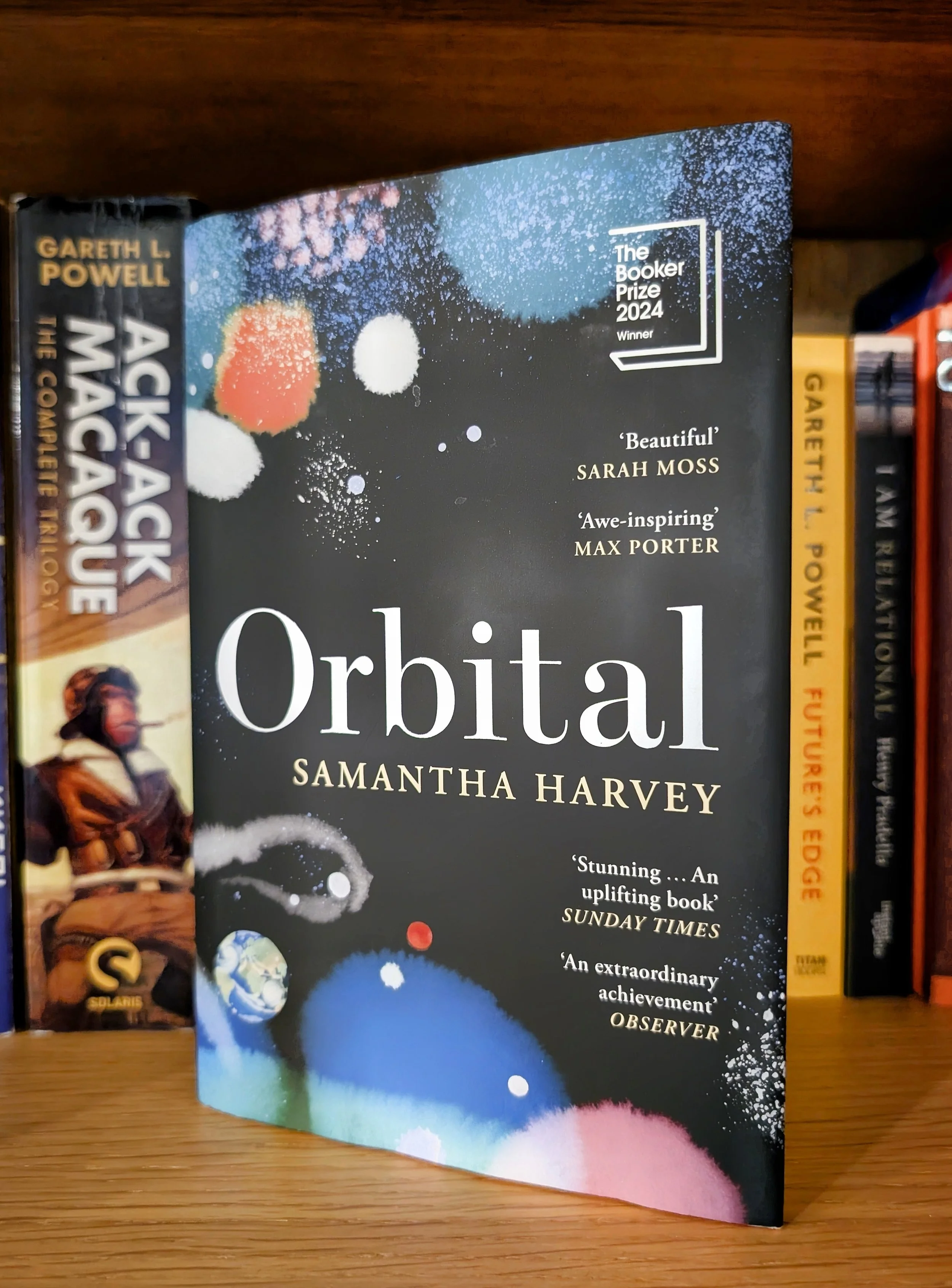
The Booker Prize-winning space novella by Samantha Harvey.
Another pick from a National Trust used bookshop, this time from Ham House last September. I had heard of Orbital but I didn’t really know much about it. The premise seemed pretty interesting when I read the blurb, and I was really drawn in by the cover art. It being a small hardback made it feel good in the hand as well, but ultimately it fell short for me in the reading. Disappointing for a Booker Prize winning novella, overstaying its welcome despite the length.
Blurb
Life on our planet as you've never seen it before
A team of astronauts in the International Space Station collect meteorological data, conduct scientific experiments and test the limits of the human body. But mostly they observe. Together they watch their silent blue planet, circling it sixteen times, spinning past continents and cycling through seasons, taking in glaciers and deserts, the peaks of mountains and the swells of oceans. Endless shows of spectacular beauty witnessed in a single day.
Yet although separated from the world they cannot escape its constant pull. News reaches them of the death of a mother, and with it comes thoughts of returning home. They look on as a typhoon gathers over an island and people they love, in awe of its magnificence and fearful of its destruction.
The fragility of human life fills their conversations, their fears, their dreams. So far from earth, they have never felt more part - or protective - of it. They begin to ask, what is life without earth? What is earth without humanity?
Review
This was a weird book. On the one hand it was a fascinating look into the daily lives of a crew living and working aboard the International Space Station. It’s filled with very well researched detail that will definitely provide me with a concise reference if I ever need it in the future. But on the other hand, the book is so unbelievably repetitive that it got really hard to read. It’s a book of awe and wonder but not much else of substance. Like Time War this is very squarely literary fiction but unlike that book, it navigates the intersection between the literary and sci-fi genres much more elegantly. I will come straight out and say I didn’t get on with it, and I seem to have a poor track record with getting enjoyment out of literary fiction, but I can appreciate this one more.
There’s not really a story per se, and the sparse dialogue doesn’t have any punctuation. So, in effect, the reader is simply being told by the narrator that the characters said something, rather than having the characters say the thing. There is also an inordinate amount of time spent just describing Earth. Every chapter, repeating the same thing over and over again. It’s like the meme of Tolkien describing trees, but more actually, it’s very much like the chapter Of Beleriand and Its Realms from The Silmarillion where Tolkien takes the entire chapter to describe the map in excruciating detail. But honestly, that was one chapter in one book, and I would much rather read that a second time. This was every chapter. And sometimes even the only content of multiple entire chapters. Just describing what the astronauts might be able to see out of the window as the sun lights different countries and the night comes on. It happens every forty-five minutes for the ISS, don’t you know? So it needs to be repeated at least three times per chapter, every chapter, only changing the landmarks and telling you what country is coming up next. If this review feels repetitive already, then imagine it for an entire book. It felt more like an exercise in descriptive writing than something you’d write for publication. And par for the course with my foray into literary fiction, its insights into human nature were rather banal. Folksy wisdom wrapped in florid language and statistics about orbital mechanics to make it seem more profound. In that sense it was rather more like How Do You Live? but at least that was written with a young adult audience in mind. There was even an entire chapter dedicated to trotting out the tired metaphor of comparing the history of the universe to a calendar in which, oh so profoundly, humanity only appears in the last minute of the last day of the year! I don’t even know why that was in there. It didn’t fit at all. It really felt like the author learned this thing and absolutely had to shove it into the book somewhere.
I really need to stop doing this to myself.