Book Review: This Is How You Lose The Time War
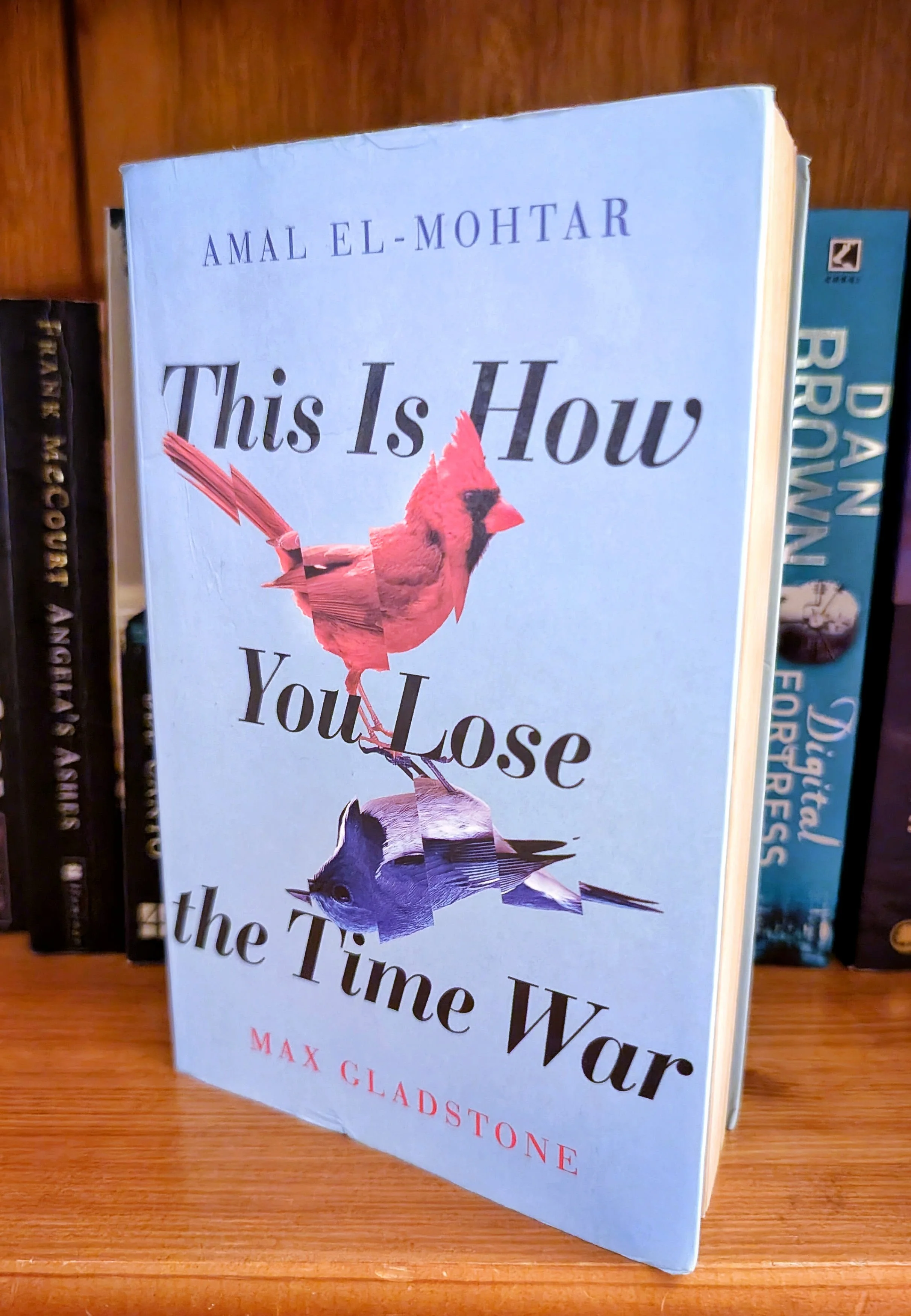
Literary fiction masquerading as sci-fi.
I, like many others, first heard about This Is How You Lose The Time War because of the Bigolas Dickolas Twitter incident of 2023, in which an innocuous tweet from a Trigun (an anime series) stan account gushing about the book absolutely catapulted it up the Amazon charts. An impressive feat, and I had kept the book on my TBR wish list pretty much ever since, until I happened across a copy in a second-hand bookshop sometime last year. I couldn’t pass up £1.75, naturally, and bought it. Having now read it, I have thoughts.
Blurb
Co-written by two award-winning writers, This Is How You Lose the Time War is an epic love story spanning time and space.
Among the ashes of a dying world, an agent of the Commandant finds a letter. It reads: Burn before reading.
Thus begins an unlikely correspondence between two rival agents hellbent on securing the best possible future for their warring factions. Now, what began as a taunt, a battlefield boast, grows into something more. Something epic. Something romantic. Something that could change the past and the future.
Except the discovery of their bond would mean death for each of them. There's still a war going on, after all. And someone has to win that war. That's how war works. Right?
Review
To get it out of the way first: I really didn’t like this book. It all started off fine and intriguing, and I could appreciate the style of alternating chapters from Red and Blue’s (the two main characters) viewpoints with letters written to one another spliced in between. Each chapter would involve one of the characters in the middle of a mission for their side in the time war as they happen across a correspondence written to them by the other. These letters are written in increasingly creative ways as the story unfolds, in order to avoid detection by their own respective commanding officers.
It’s an interesting premise, and a good hook, but ultimately the gimmick wore thin as my frustrations with the book mounted. First of all, let’s go over what I think the book does well: The yearning. This is, at its heart, a sapphic love story full of the most poetic and intense yearning as Red and Blue continue their illicit correspondence. The two women bond over a love for Victorian writing etiquette and so all of their letters to each other carry that flavour. It would be a wonderful aspect to an incredible book, but the story is so laser-focused on being literary in this way that it neglects so much that could have made it great.
So that’s it. That’s the compliment. Now for the rest: The worldbuilding stinks to high heaven. The prose is so purple it’s barely on the visible spectrum. It’s so pretentious with its head so far up its own arse that it can see out of its mouth. This is not sci-fi—it is squarely literary fiction deigning to incorporate a semblance of icky genre fiction into its backdrop that feels like a disingenuous and patronising attempt to give sci-fi some legitimacy as a form of literature.
The result is that none of the settings, nor the time war itself, feel relevant to the story in any way. I love a bit of technobabble in sci-fi, but making up sci-fi sounding words only works when there’s some verisimilitude. If the worldbuilding isn’t providing the weight behind the terminology, it just sounds scattershot. And this book just throws scenes and settings and technobabble and time periods and flashy sci-fi sounding stuff out there like dropping a bag of Skittles on the floor. Nothing sticks. Nothing feels consequential. There’s no reason for Red or Blue particularly to be in Atlantis or Rome or London or Omicron Persei 8, or whenever or wherever they are at the start of a chapter. The events (basically finding another elaborately hidden letter) could have happened anywhere and anywhen. And it meant I didn’t care about the time war. I didn’t care about the supposed danger they were in when they could just pull some random new technology out to get them out of it. Not that they ever needed to get out of it. Oh, they can just survive standing near nuclear bombs because they have special organs, and oh, they can’t die falling from a great height because they, uhh, can’t; and of course they can stand in lava because they’re future people who can time travel therefore they can do anything the plot desires on a whim.
I was a little irritated by all this, and I was beginning to think of it in the same terms as when I read How Do You Live, but my breaking point into really disliking what this book was doing was a factual error about dinosaurs that a cursory Google search could have corrected. I realised then that the reason the worldbuilding was rubbing me up the wrong way was because it was incredibly lazy.
And a note on the prose: Near the end, the book seems to gain some self-awareness when one of the characters says that her prose is beginning to purple. The issue here is that the entire book’s prose is purple. Some of it, mixed with the aforementioned weightless technobabble, is downright word salad.
Coming to the characters, there’s not much really to say. Red and Blue are basically the same for most of the book, just on different sides. That’s probably by design and some kind of meta-narrative about the nature of war, but it did make it difficult to tell them apart.
Anyway, that was more of a rant than a review, but I can’t recommend this book at all. Unless you’re into literary fiction, or are specifically looking for the sapphic yearning, then you might love it. But certainly not if you’re a sci-fi/fantasy fan looking for something with substance.